High availability to eliminate single points of failure. If one server goes down, the website should not go offline.
Scalability and acceptable performance under peak load. Typically, this also requires redundancy, so the load can be balanced across servers.
When planning for scalability and failover, it is important to consider all of the runtime processes and hosts on which the website depends. This includes the web servers running the Sitefinity project, the database servers, any integrated data sources that feed content to the website and the hardware or cloud platform on which the runtime processes are hosted.
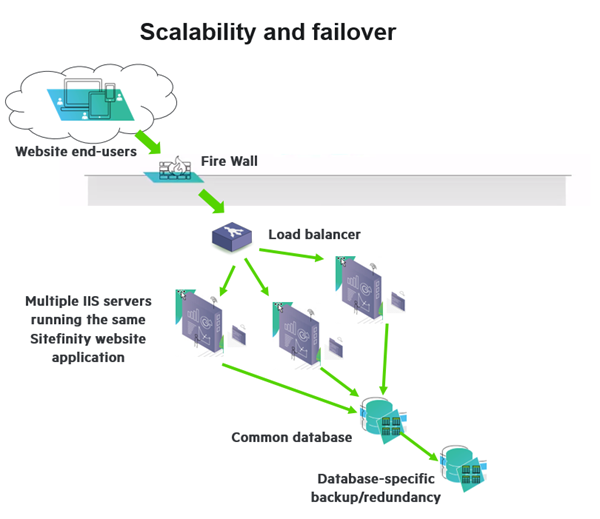
Load balancing for the web server and Sitefinity project can be provided by 3rd party hardware or software. With load balancing, requests go first to the load balancer, which then distributes them across multiple nodes where the web server is running the Sitefinity web application. In the case of failure, the load balancer re-directs traffic to the live nodes until the failed nodes come back online.
The following illustrates what an architecture designed for scalability and failover might look like using three IIS servers and one database server that is configured to act as a backup. For more suggestions, see Sitefinity documentation on hosting recommendations and best practices.
 High availability to eliminate single points of failure. If one server goes down, the website should not go offline.